
The Search for Self in Strange Tides
On unreliable memory, stunted growth, and wrestling for clarity in The Sea by John Banville

For the second month in a row, I find myself unsettled—nearly mildly depressed I daresay—at the untidy (and purposefully puzzling) ending of a beautifully written book.
Ultimately, I don’t think John Banville is the storyteller for me; his intricately crafted sentences, however, I can—and do—greatly admire.
The Sea is primarily a novel about memory—memory and its might and its vastness and its unpredictably. At times the tide is low and steady; other times it is high and overwhelming. Waves never settle in one place. Depths are constantly changing. And memory, like the nature of the sea, is at its core unreliable.
Although it is transformed into a boarding house, the bones of The Cedars do not match those of the house in Max’s memory:
As I padded behind Miss Vavasour with my bag in my hand, like the well-mannered murderer in some old black-and-white thriller, I found that the model of the house in my head, try as it would to accommodate itself to the original, kept coming up against a stubborn resistance. Everything was slightly out of scale, all angles slightly out of true. The staircase was steeper, the landing pokier, the lavatory window looked not on to the road, as I thought it should, but back across the fields. I experienced a sense almost of panic as the real, the crassly complacent real, took hold of the things I thought I remembered and shook them into its own shape. Something precious was dissolving and pouring away between my fingers. Yet how easily, in the end, I let it go. The past, I mean the real past, matters less than we pretend.”
- John Banville, The Sea
How many times have you experienced such a phenomenon?
I once had the opportunity to walk through the childhood home of my younger years and felt precisely the same way: doorways were narrowed, the staircase much steeper, the rooms incredibly smaller. It felt as if I were a giant passing through a long-forgotten dream.
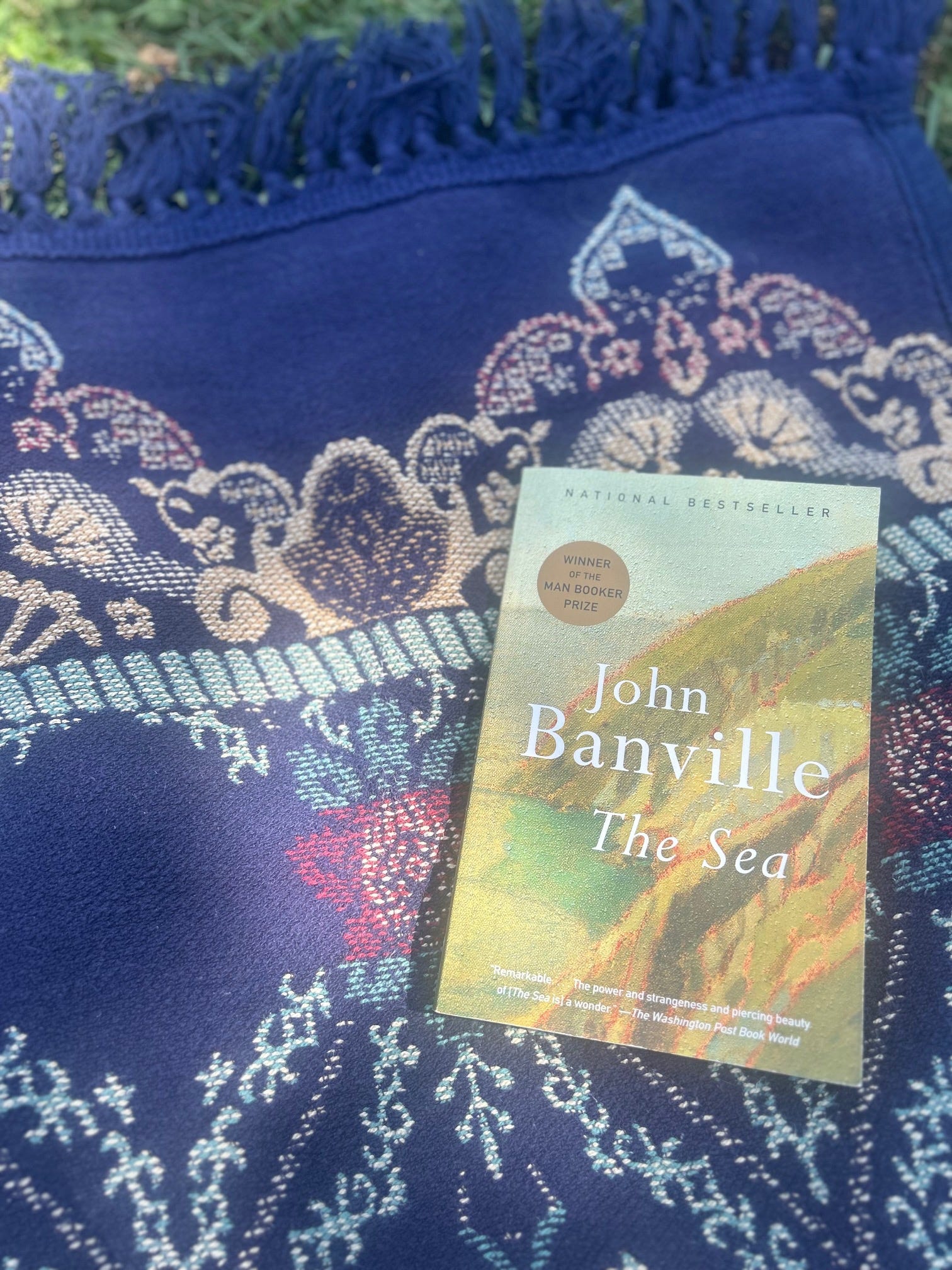
In this story, the sea, (I believe), serves as more than one symbol, however. Memory and the subconscious are at play in the waves, to be sure, but I think the ocean is also serving as a symbol of the natural forces in life—and perhaps death itself.
We can infer that Chloe and Myles meet such a force head-on, with the intent of taking death into their own hands—in a bold “moment of earthly expression” as described on page 137 of the novel—but ultimately, we know the tides will reach each and every soul one day. The sea, just like death, is an inevitable force that will take Max, too.
I can’t help but think, however, that the dissatisfaction I feel for this story as a reader stems from the heart of the narrative itself—which is the dissatisfaction raging in Max himself.
From the start, we are unsure of exactly why Max is even drawn to the Graces, or if he even likes Chloe. Once his attraction for Mrs. Grace wanes, it is ever more apparent that the only thing really keeping Max around this dysfunctional and perverse family is his strong aversion to his own social and economic status. He is curious about the family, to be sure, but not enough to voice any sort of question or develop an analysis of his own—a dangerous place to be at such an impressionable age.
It’s a sort of stunted growth we observe here; once the traumatic experience of witnessing the death of the twins transpires, Max never quite leaves the stunned shore.
Tragically, Max spends the rest of his life searching for a clarity, a sense of self, I don’t think he ever fully develops.
And while it is true that the dead live on in those we leave behind on this earth—a point mostly clearly illustrated in the character of Rose, maintaining The Cedars long after the Graces are gone and serving as the sole physical reminder of their existence —it is not the only chance at life we get.
At his core, Max lacks a sense of self he is only just now coming to terms with. Faced with his failing memory of the Graces, the inevitable and painful death of his wife, and a strained present-day relationship with his daughter, Max is ill-prepared on just how exactly he is to live out his final days on earth.
I suspect a thorough knowledge of the artist Pierre Bonnard and his works would derive deeper meaning for readers in the final pages of the novel. Regardless, we know this painter is paralleled with the character of Max Morden, an art historian on a lifelong search for a clarity he can’t seem to grasp:
“Could I have lived differently? Fruitless interrogation. Of course I could, but I did not, and therein lies the absurdity of even asking. Anyway, where are the paragons of authenticity against whom my concocted self might be measured? In those final bathroom paintings that Bonnard did of the septuagenarian Marthe he was still depicting her as the teenager he had thought she was when he first met her. Why should I demand more veracity of vision of myself than of a great and tragic artist? We did our best, Anna and I. We forgave each other for all that we were not. What more could be expected in this vale of torments and tears? ‘Do not look so worried,’ Anna said. ‘I hated you too, a little, we were human beings, after all.’ Yet for all that I cannot rid myself of the conviction that we missed something, that I missed something, only I do not know what it might have been.”
-John Banville, The Sea
Perhaps, like the final Bonnard paintings, Max never grew beyond the stunned shore of that fateful summer with the Graces. Forever swimming in those strange tides, like the troubled and confounded boy of his youth, he is now left alone with a self that never truly existed outside of the Graces—or Anna.
Perhaps the clear vision he demands of himself is precisely what he is convicted of missing.
To live a life only knowing what or who you don’t want to be is only half of the equation; One must also ask, who do I want to be?
Out of all the questions this book asks—and it asks some important ones—this is the question that I believe is missing. The entire narrative of Max’s childhood is one of running from his social and economic status and, perhaps more importantly, passivity; he merely observes and complies with the changing tides—no matter how strangely they may churn. And I think this is precisely what disappoints and unsettles me the most.
It’s a similar experience I felt with the nameless narrator in Daphne du Maurier’s Rebecca; the unlikely heroine (or rather, anti-heroine), simply chooses to fade into the story, rather than take up a defining role and recognize what parts could use re-writes or edits.
Consequently, I interpret The Sea as a cautionary tale to search for a sense of self outside of the forces and personalities you encounter. Should you fail to do so, you could spend your final days adrift in quite a tumultuous sea—a sea that will inevitably overtake you and the legacy you choose to lead or abandon all together.
Of course, I’m curious as to what other thoughts are out there: Did this book leave you as unsettled as it did me? How did you interpret the sea? And what exactly is it that Max might have missed out on?